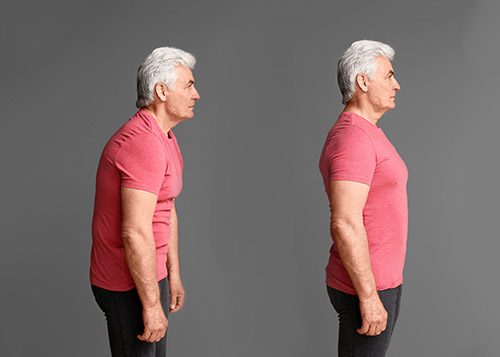
What poor posture actually means
Poor posture isn’t about effort or willpower. It’s about how your spine and surrounding muscles have adapted, over time, to the positions you spend most of your day in. Most people with poor posture aren’t aware of it, the body is remarkably good at compensating.
Common patterns include a head that sits forward of the shoulders, a rounded upper back, elevated shoulders, and a flattening of the natural curve in the lower back. The main driver is sustained posture, desk and screen work, long commutes, trades work, and carrying young children all play a part. Even 20 to 30 degrees of forward head tilt more than doubles the load on the neck and upper back.
Poor posture doesn’t always cause immediate pain, but the strain adds up. Identifying it early makes correction considerably more straightforward, which starts with a proper assessment rather than a guess.
What poor posture can lead to
- Neck pain and stiffness by the end of the day
- Upper and lower back aching after sitting or driving
- Tension headaches from the base of the skull
- Rounded or elevated shoulders that won’t relax
- Fatigue after normal activities
- Reduced breathing capacity from a compressed chest
How chiropractic care can help
What to expect at your first visit
Your first appointment includes time to go through your health history, any symptoms and your daily lifestyle and work, followed by a physical examination assessing your posture, spinal movement and muscle function.
Dr Marcello explains what he’s found and what it means. If care is likely to help, he’ll outline an approach; if it’s not the right fit, he’ll point you in the right direction. New patients are seen for $78 (normally $140), with parking right at the door.
Every care plan is tailored to you. By addressing areas of spinal and nervous system stress, chiropractic care aims to support your body’s natural ability to function, move and feel its best. If you have any questions, we’re always happy to talk through whether care is right for you.
Common questions.
Can a chiropractor help with poor posture?
Yes, in many cases. Chiropractic care addresses the spinal restrictions and muscle imbalances that contribute to poor posture. A proper assessment shows where your spine isn’t moving well and what’s driving your pattern, and most people find a combination of hands-on treatment and specific advice produces gradual, lasting change.
How long does posture correction take?
It varies. Patterns built up over years take longer to shift than recent ones. Many people notice improvement within the first few visits, with more significant change over weeks to months. How consistently you apply the advice between visits matters too.
Can poor posture actually be fixed, or just managed?
For most people meaningful improvement is possible, the spine and supporting muscles respond to consistent input. Complete correction depends on the severity and other factors; management is sometimes the realistic goal for long-standing structural changes.
Can chiropractic help with forward head posture or text neck?
Yes. Forward head posture is one of the most common patterns we see, particularly in people on screens and devices. Care can improve mobility in the neck and upper back, reduce muscle tension and give you strategies to change the habits driving it.
Will I need to do exercises at home?
Most likely, yes. Hands-on treatment addresses joint restriction and muscle tension, but maintaining better posture means strengthening the muscles that support it. Dr Marcello gives practical, specific exercises designed to fit into a normal day.
What age should someone see a chiropractor for posture?
There’s no minimum age. Dr Marcello has postgraduate paediatric training and sees all ages, including children and teenagers. Patterns often begin early with screen time, and addressing them while the spine is still developing tends to produce better outcomes.